| Technical Specifications | L600 |
| Radar | Front and rear dual laser radars |
| External dimensions | 950*650*250mm |
| Rotation diameter | 965mm |
| Lifting height | 60mm |
| Lifting platform dimensions | 850*600mm |
| Self-weight | 150kg |
| Load capacity: | 600kg |
| Travel speed | 1.5 m/s |
| Motion Control | Differential drive, supporting forward, backward and rotation |
| Positioning Accuracy | ±10/5mm (Laser/QR code) |
| Battery type | Lithium iron phosphate |
| Capacity/Rated Voltage | 24Ah/48V |
| Charging time after full discharge | ≦1.5H |
| Battery life | 6-8 hours |
| Multiple safety features | Emergency stop button, safety bumper, audible and visual warning signals |
| Passability | Climbing capacity≤3° step height≤ 5mm gap pass≤ 30mm |
| Communication | Support WiFi and seamless roaming;5G optional |
Technical Info
Applications
Downloads
Technical Info
L600 Low-Profile Lifting Robot – Dependable 600kg Autonomous Lifting in Just 965mm Rotation
Category:Low-Profile Lifting Robot,Latent mobile robot
The L600 Low-Profile Lifting Robot is purpose-built for material handling operations in space-constrained logistics environments, including narrow-aisle warehouses, assembly line side-feeding stations, and automated production cells. Its design philosophy prioritizes volumetric efficiency: by minimizing the robot’s vertical clearance, it enables autonomous load transport beneath racking systems, workstations, roller conveyors, and semi-automated workbenches, thereby reclaiming floor space that would otherwise be reserved for manual truck maneuvering or fork-turn radii. This architectural choice directly addresses the intensifying industrial requirement for higher storage density without expanding facility footprints.
Technical specifications
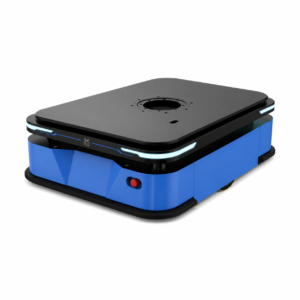
From a mechanical perspective, the L600 presents external dimensions of 950 mm in length, 650 mm in width, and a remarkably low height of 250 mm. This ultra-low chassis allows it to ingress under standard pallet racks with under-clearance as low as 280 mm, a feature seldom matched by conventional automated guided vehicles.
The lifting platform measures 850 mm by 600 mm, compatible with Euro-pallets, tote boxes, and custom fixture plates, and provides a vertical lift stroke of 60 mm—sufficient for engaging with most fixed transfer stations, conveyor beds, and docking pins without requiring supplementary lifting actuators. The robot’s rotation diameter is specified at 965 mm, which, coupled with its differential drive configuration, permits zero-radius turning within its own footprint. This kinematic capability substantially reduces the aisle width required for 180° heading changes, enabling dense grid-based traffic patterns that maximize usable storage area.
The motion control system employs a differential drive arrangement supporting forward, backward, and on-the-spot rotation, with a maximum travel speed of 1.5 m/s. While this speed is moderate relative to larger autonomous vehicles, it is deliberately calibrated to ensure load stability during acceleration, deceleration, and cornering, particularly when transporting high-center-of-mass payloads approaching the 600 kg rated capacity. The robot’s self-weight is 150 kg, yielding a payload-to-weight ratio of 4:1, which reflects efficient structural engineering achieved through high-strength steel and aluminum alloy construction.
Navigation and localization are realized through a hybrid sensor fusion architecture. The L600 is equipped with front and rear dual laser radars, providing 360° omnidirectional perception for simultaneous localization and mapping (SLAM), obstacle detection, and dynamic path re-planning. For absolute positioning, the system supports two independent referencing modes: laser reflector-based localization achieves a repeatability of ±10 mm, while QR code visual landmarking improves this precision to ±5 mm. This dual-mode redundancy ensures reliable docking performance even in environments where one sensing modality is temporarily compromised—for instance, under varying lighting conditions or in areas with sparse reflective surfaces.
The onboard power system utilizes a lithium iron phosphate (LiFePO₄) battery pack rated at 24 Ah capacity and 48 V nominal voltage. This chemistry is selected for its thermal stability, long cycle life, and resistance to thermal runaway, making it suitable for continuous unattended operation. The battery provides 6 to 8 hours of runtime under standard duty cycles, and can be fully recharged from a complete discharge state within 1.5 hours via conductive contact charging, supporting opportunity charging during shift intervals or brief operational pauses.
Safety provisions are comprehensive and multi-layered. Physical protection includes front and rear mechanical safety bumpers that trigger emergency braking upon contact, supplemented by two emergency stop buttons accessible from opposite ends of the chassis. Proximity-based hazard mitigation is enabled by the dual LiDAR units, which define configurable warning and deceleration zones, allowing the robot to reduce speed progressively rather than executing abrupt halts. Audible and visual warning signals—including a high-output buzzer and a 360° visible LED tower—alert nearby personnel during motion, turning, and fault states, ensuring compliance with ISO 13849 and EN 1525 safety standards.
The L600 exhibits practical terrain passability with a climbing capacity of 3° gradients, step traversal up to 5 mm in height, and gap crossing of 30 mm, ensuring reliable performance across common industrial flooring irregularities such as expansion joints, threshold strips, and minor surface depressions. For communication and fleet integration, the robot supports WiFi with seamless roaming across multiple access points, with an optional 5G module for environments requiring ultra-low latency or high-bandwidth data transmission. Full compatibility with standard interface protocols—including VDA 5050—enables seamless orchestration by warehouse execution systems (WES) and manufacturing execution systems (MES), facilitating dynamic task allocation, traffic prioritization, and real-time fleet coordination.
In summary, the L600 integrates a compact mechanical envelope, dual-LiDAR hybrid navigation, sub-centimeter positioning accuracy, high-capacity lithium power, and robust safety mechanisms into a single autonomous platform. Its 600 kg payload, 1.5 m/s travel speed, 60 mm lift height, and 965 mm rotation diameter collectively deliver a versatile, space-efficient, and operationally reliable solution for modern intralogistics workflows, materially reducing manual handling while improving throughput, safety, and storage density.
Applications
Downloads